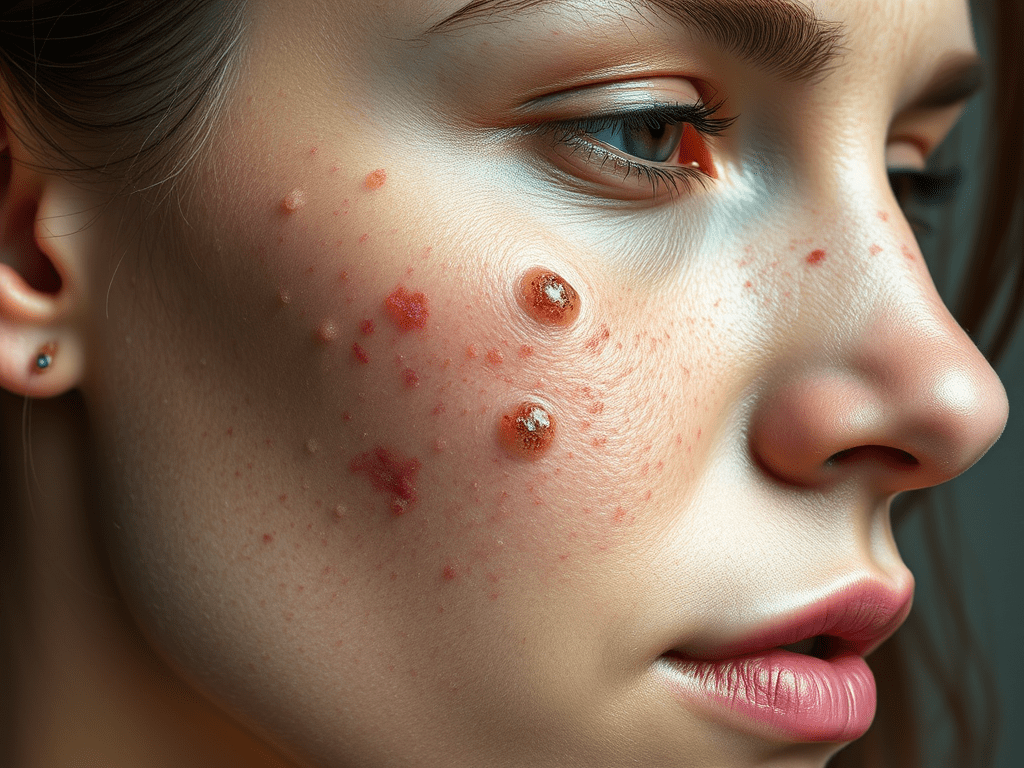
Polycystic ovary syndrome (PCOS) presents with acne, hirsutism, alopecia, and acanthosis nigricans. This article reviews pathophysiology, clinical features, and evidence-based dermatologic management for physicians.
Introduction
Polycystic ovary syndrome (PCOS) affects an estimated 8–13% of reproductive-age women, with up to 70% undiagnosed. Beyond reproductive and metabolic complications, PCOS frequently presents with cutaneous manifestations, often serving as the first clinical clue. For dermatologists and primary care physicians, recognition and appropriate management of these signs is essential for both patient outcomes and quality of life.
Pathophysiology Relevant to Dermatology
PCOS is characterized by hyperandrogenism, insulin resistance, and ovulatory dysfunction.
- Androgen excess stimulates sebaceous gland activity → acne, seborrhea.
- Follicular miniaturization under androgen influence → androgenic alopecia.
- Increased 5α-reductase activity in hair follicles → hirsutism.
- Insulin resistance leads to hyperinsulinemia, which enhances ovarian theca cell androgen production and contributes to acanthosis nigricans.
Dermatologic Manifestations of PCOS
1. Acne Vulgaris
- Typically cystic, persistent, and resistant to standard therapy, often localized to the mandibular region and lower face.
- Pathogenesis: androgen-driven sebaceous hyperplasia and altered keratinocyte proliferation.
- Management:
- Topical: retinoids, benzoyl peroxide, antibiotics.
- Systemic: oral contraceptives (first-line for androgen-mediated acne), spironolactone (50–200 mg daily), isotretinoin in refractory cases.
2. Hirsutism
- Defined as excessive terminal hair growth in a male pattern distribution, affecting up to 70% of PCOS patients.
- Severity quantified by the modified Ferriman-Gallwey score (≥8 indicative of hirsutism).
- Management:
- Pharmacologic: combined oral contraceptives, spironolactone, finasteride, flutamide (rarely, due to hepatotoxicity).
- Non-pharmacologic: laser hair removal, electrolysis, topical eflornithine.
3. Female-Pattern Hair Loss (FPHL)
- PCOS-related androgenic alopecia manifests as diffuse thinning at the vertex and crown with preservation of the frontal hairline.
- Management:
- Topical minoxidil (2–5%).
- Anti-androgen therapy (spironolactone, finasteride in postmenopausal women or those on contraception).
- Adjuncts: platelet-rich plasma (PRP), microneedling.
4. Acanthosis Nigricans (AN)
- Presents as velvety, hyperpigmented plaques in intertriginous areas (neck, axillae, groin).
- Strongly associated with insulin resistance and increased risk of metabolic syndrome.
- Management:
- Address underlying insulin resistance (weight loss, metformin, GLP-1 receptor agonists).
- Topical keratolytics (retinoids, ammonium lactate, urea).
- Cosmetic: laser, chemical peels for refractory cases.
Diagnostic and Clinical Considerations
- The Rotterdam criteria remain the most widely used: diagnosis requires two of three features—oligo/anovulation, hyperandrogenism (clinical or biochemical), and polycystic ovarian morphology on ultrasound.
- Dermatologists are often the first point of entry for PCOS patients presenting with acne or hirsutism.
- Consider screening for metabolic syndrome, type 2 diabetes, and cardiovascular risk factors in patients with cutaneous stigmata of PCOS.
Multidisciplinary Management
Dermatologic treatment should be integrated with endocrinology and gynecology care. Optimal outcomes require:
- Lifestyle modification: caloric restriction, exercise.
- Hormonal regulation: combined oral contraceptives.
- Insulin sensitization: metformin, GLP-1 analogs.
- Dermatologic intervention: targeted therapy for acne, hirsutism, alopecia, and AN.
Conclusion
PCOS is a multisystem disorder with cutaneous manifestations that frequently bring patients to dermatologic care. Recognizing acne, hirsutism, alopecia, and acanthosis nigricans as potential indicators of underlying PCOS enables early intervention and coordinated multidisciplinary management. For physicians, integrating dermatologic findings with systemic evaluation is critical for comprehensive care.
References
- Azziz R, et al. Polycystic ovary syndrome. Nat Rev Dis Primers. 2016;2:16057. doi:10.1038/nrdp.2016.57
- Martin KA, et al. Evaluation and treatment of hirsutism in premenopausal women: an Endocrine Society clinical practice guideline. J Clin Endocrinol Metab. 2018;103(4):1233–1257. doi:10.1210/jc.2018-00241
- Yildiz BO, et al. Impact of obesity on the risk for polycystic ovary syndrome. J Clin Endocrinol Metab. 2008;93(1):162–168. doi:10.1210/jc.2007-1834
- Rosenfield RL, Ehrmann DA. The pathogenesis of polycystic ovary syndrome (PCOS): the hypothesis of PCOS as functional ovarian hyperandrogenism revisited. Endocr Rev. 2016;37(5):467–520. doi:10.1210/er.2015-1104
 Zehn Skin and Health
Leave a comment