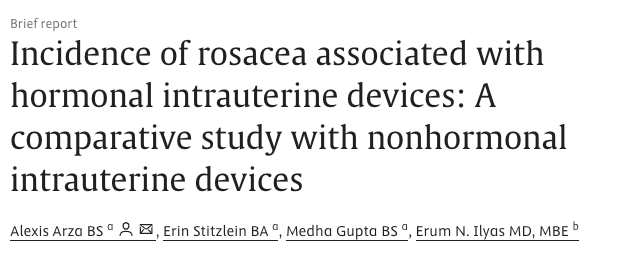
A recent study has investigated the potential link between hormonal intrauterine devices (IUDs) and the development of rosacea, a chronic skin condition causing facial redness and inflammation. The research, published in the Journal of the American Academy of Dermatology, compared the incidence of rosacea among users of different types of IUDs – hormonal and nonhormonal (copper).
Researchers conducted a large, multi-center study analyzing data from women aged 18-50 who had IUDs inserted. They tracked the diagnosis of new rosacea cases (using ICD-10-CM code L71) at 1, 3, and 5 years following IUD insertion. The study included women using three types of hormonal IUDs – Liletta, Mirena, and Skyla – and compared them to women using nonhormonal copper IUDs. Women with pre-existing rosacea or those who had their IUDs removed during the study period were excluded to ensure the results focused on new-onset rosacea potentially related to IUD use.
The findings revealed a significant difference in rosacea incidence depending on the type of IUD used. Liletta and Mirena, both hormonal IUDs, were associated with a significantly higher incidence of rosacea compared to copper IUD users at all time points (1, 3, and 5 years post-insertion).
Specifically, at one year post-insertion:
- Liletta showed the highest incidence rate of rosacea, with a rate ratio 1.665 times higher than copper IUD users – a statistically significant increase.
- Mirena also demonstrated a significantly higher rosacea incidence, with a rate ratio 1.389 times that of copper IUD users.
- Skyla, another hormonal IUD, had a higher incidence rate than copper IUDs, but this increase was not statistically significant.
Similar trends were observed at 3-year and 5-year follow-ups. Liletta consistently showed the highest incidence rates and rate ratios for rosacea, followed by Mirena, both with statistically significant increases compared to copper IUDs. Skyla, however, did not show a statistically significant difference in rosacea incidence compared to copper IUDs at any of these later time points either.
The study authors concluded that hormonal IUDs, particularly Liletta and Mirena, are associated with a significantly increased risk of developing rosacea compared to nonhormonal copper IUDs. Interestingly, Skyla did not show the same significant association, which the authors suggest could be related to its lower and slower release rate of the hormone levonorgestrel compared to Liletta and Mirena. This research highlights that hormone manipulation through IUDs might play a role in triggering or worsening rosacea in some women, and that nonhormonal IUD options may be less likely to influence the development of this skin condition.
It is important to note that this study demonstrates an association, not necessarily causation. Women considering IUDs, particularly those with risk factors for rosacea or concerns about skin conditions, may want to discuss these findings with their healthcare providers to make informed decisions about contraception.
 Zehn Skin and Health
Leave a comment