
Hidradenitis suppurativa (HS) is a chronic inflammatory skin condition that causes painful bumps, abscesses, and scarring. While medications are often necessary, there’s growing interest in non-drug approaches to manage HS and improve quality of life. Let’s explore some of these treatments and the evidence behind them.
Dietary Supplements
- Zinc Gluconate:
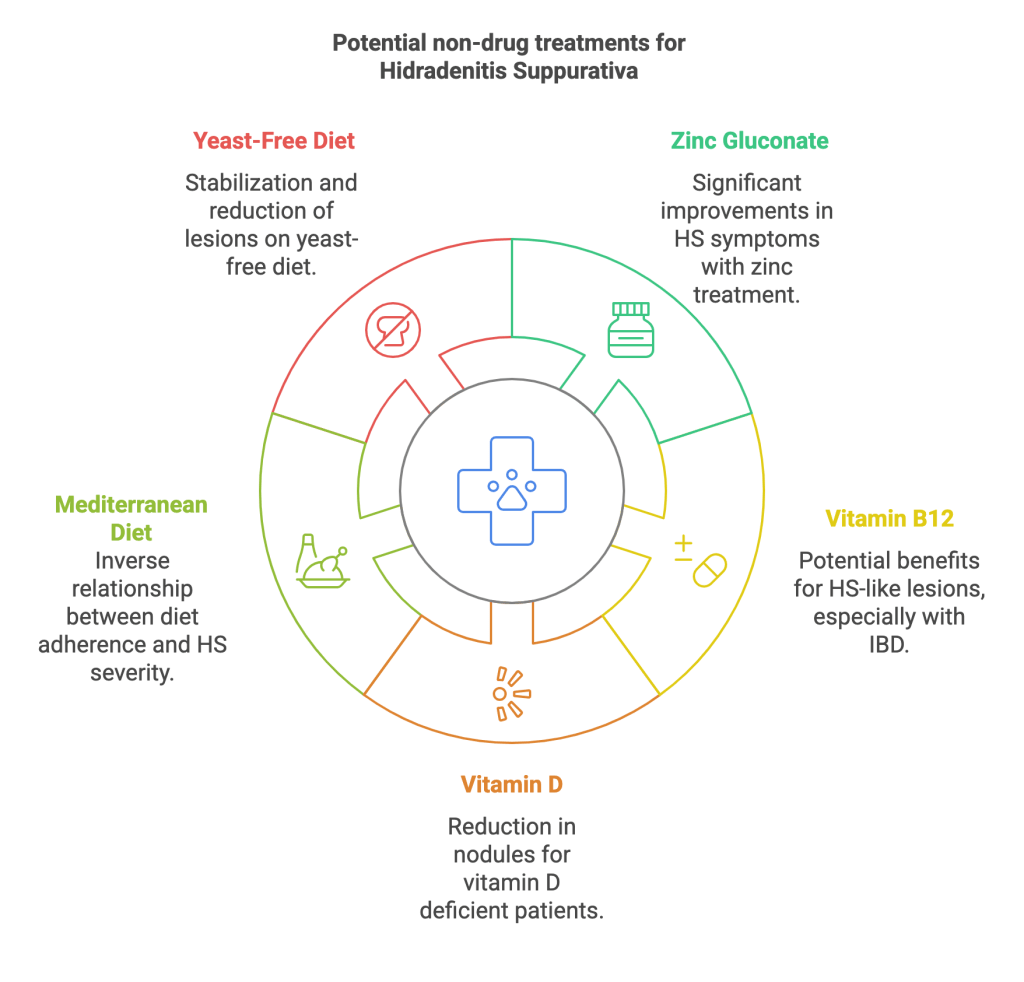
- A 2020 controlled retrospective study by Molinelli et al. involved 92 patients with mild-to-moderate HS who were previously treated with oral tetracyclines. The study investigated the effects of oral zinc gluconate (90 mg/day) and nicotinamide (30 mg/day) as maintenance treatment for 90 days in 47 patients compared to 45 untreated control patients. The results showed significant decreases in lesion severity, improved quality of life, reduced pain, and shorter flare duration in the treated group compared to the control group.
- A pilot study by Brocard et al. in 2007 included 22 patients with HS refractory to conventional treatment, treated with 90 mg/day zinc gluconate. All individuals showed improvement, either partial (63.6%) or complete (36%). Adverse effects were observed in only 3 patients.
- Another study evaluated the efficacy of zinc gluconate (90 mg/day) and topical 2% triclosan in 66 patients with mild-to-moderate HS and reported a significant improvement at 3 months in disease severity, the number of inflammatory nodules and flares, and quality of life. Gastrointestinal adverse effects were observed in 22 individuals, of whom 5 discontinued treatment.
- Vitamin B12: A case series by Mortimore and Florin in 2010 found that vitamin B12 (100 mg/day) may help improve HS-like skin lesions, especially those associated with inflammatory bowel disease (IBD). The small number of patients and associated IBD make translating this study to a more generalized population difficult.
- Vitamin D: Multiple studies have linked vitamin D deficiency/insufficiency with HS disease burden and severity. A pilot study by Guillet et al. in 2015 included 44 patients with HS of any stage and vitamin D deficiency. Vitamin D supplementation decreased the number of nodules by 75% in these patients.
Dietary Interventions
- Mediterranean Diet: A cross-sectional case-control study by Barrea et al. in 2019 evaluated 82 patients with HS of any stage. The study found that HS severity was inversely proportional to the level of patient adherence to the Mediterranean diet.
- Yeast-Free Diet: A prospective pilot study by Cannistrà et al. in 2013 included 12 patients with HS of any stage. All patients showed stabilization and reduction in skin lesions after following a yeast-free diet for 3 months. Lesion recurrence was observed in all patients who resumed consumption of yeast or wheat.
Lifestyle Modifications
- Weight Loss: An uncontrolled retrospective study by Kromann et al. in 2014 included 249 patients with HS of any stage who underwent bariatric surgery. After bariatric surgery with significant weight loss, complete and partial remission was observed in 17 (48.6%) and 7 (20%) patients, respectively, out of 35 patients with HS.
- Laser Hair Removal:
- A prospective randomized controlled study by Tierney et al. in 2009 investigated the effects of Nd:YAG laser hair removal in 22 patients with moderate-to-severe HS. After 4 monthly sessions, reductions in HS severity were observed: 65.3% in all anatomical areas, 73.4% in the inguinal area, 62% in the axillary region, and 53.1% in the inframammary area.
- Another prospective randomized controlled study by Mahmoud et al. in 2010 involved 22 patients with moderate HS. The study used Nd:YAG laser with 4 monthly sessions and found a 72.7% improvement on the treated side versus 22.9% on the symmetrical control side.
Important Considerations
- The evidence for non-drug treatments for HS is still emerging, and more research is needed to confirm their effectiveness.
- These treatments may not be suitable for everyone, and it’s essential to discuss them with your doctor before trying them.
- Non-drug approaches may be used alongside medications to provide a more comprehensive treatment plan.
If you’re living with HS, talk to your doctor about all your treatment options, including non-drug therapies. By combining the right treatments, you can take control of your HS and improve your quality of life.
Information observed from a 2020 Article by Serra Garcia et al.
 Zehn Skin and Health
Leave a comment