
Surgical interventions and laser therapies are important treatment modalities for hidradenitis suppurativa (HS), particularly when medical therapies alone are insufficient to control the disease. These approaches range from minimally invasive procedures to more extensive surgical excisions, tailored to the severity and extent of HS lesions.
In-Office Procedures for HS
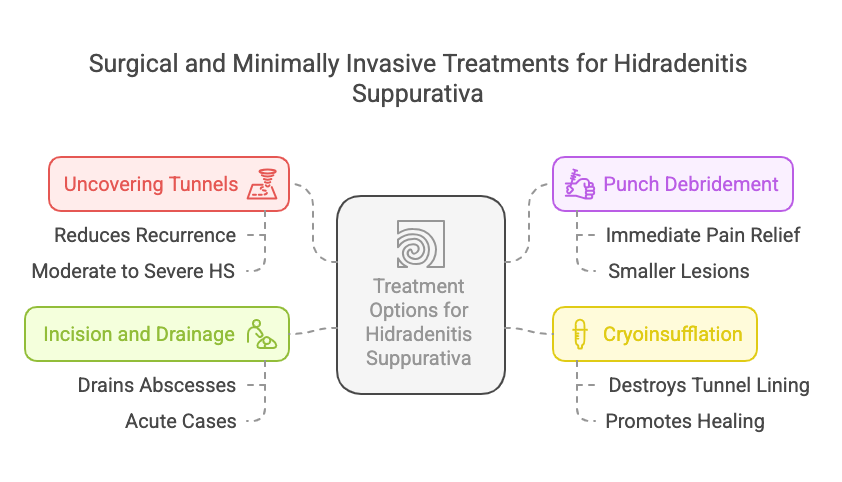
- Uncovering Tunnels (Deroofing): This surgical technique involves surgically removing the “roof” of the inflamed tunnels to expose the underlying sinus tracts. This procedure is aimed at reducing the recurrence of lesions by eliminating the tunnel environment. It is considered a more definitive approach than incision and drainage and is typically used for moderate to severe HS.
- Punch Debridement (Limited Unroofing): This minimally invasive procedure involves using a punch tool to remove a small core of tissue, effectively “unroofing” a single inflamed nodule or abscess. It is suitable for managing individual, smaller lesions and can provide immediate pain relief.
- Cryoinsufflation: This minimally invasive technique involves injecting liquid nitrogen directly into sinus tracts. Cryoinsufflation aims to destroy the lining of the tunnels and promote healing. Although it is considered a treatment option for Hurley Stage II and III HS, results can vary and efficacy is often limited.
- Incision and Drainage (I&D): While incision and drainage is a common surgical procedure, it is often not considered an effective definitive treatment for HS. I&D may provide short-term pain relief by draining abscesses, but it does not address the underlying disease process and lesions typically recur. I&D is now primarily reserved for acute cases with very painful, fluctuant abscesses to provide immediate symptomatic relief.
Laser Therapy: Various laser modalities are employed in HS surgery:
- Carbon Dioxide (CO2) Laser: CO2 laser therapy can be used to vaporize and remove HS sores and sinus tracts. This approach aims to surgically excise the affected tissue with precision, reducing the likelihood of recurrence in the treated area. CO2 laser is considered effective for reducing recurrence and is a standard intervention in some countries.
- Laser Hair Removal: Laser hair removal, particularly with Nd:YAG lasers, can be beneficial in early stages of HS. By targeting and destroying hair follicles, laser hair removal aims to address a primary factor in HS pathogenesis – follicular occlusion.
Surgical Removal (Wide Excision):
- Wide excision involves surgically removing all affected skin in a region. This is a more radical approach often reserved for severe or persistent HS, particularly Hurley Stage III. It aims to eliminate all diseased tissue and can be highly effective in controlling disease in the excised area. However, it can result in significant wounds that may require skin grafting or flap reconstruction for closure. Recurrence rates after wide excision vary depending on the closure technique, with secondary intention healing often associated with lower recurrence compared to primary closure, flaps, or grafts.
Botox (Botulinum Toxin):
- Botox might help with hidradenitis suppurativa (HS) because it can reduce sweating. Less sweat can mean less irritation in HS-prone areas like armpits and groin. While studies are still limited, some reports suggest Botox shots can be a helpful add-on treatment to manage sweating and possibly reduce HS flare-ups caused by moisture and rubbing. Botox isn’t a main treatment for HS, but it could be a useful way to control sweating in problem areas.
Factors Influencing Surgical Approach
The choice of surgical procedure in HS depends on several factors:
- Hurley Stage and Disease Severity: Less invasive procedures like punch debridement and laser therapy may be suitable for milder stages, while wide excision is typically reserved for severe, refractory disease.
- Location and Extent of Lesions: The anatomical location and the area affected by HS influence the surgical approach. Wide excision may be necessary for diffuse involvement, while localized lesions may be amenable to more limited procedures.
- Patient Factors: Individual patient characteristics, such as overall health, comorbidities, and patient preference, also play a role in surgical decision-making.
- Recurrence Risk: Different surgical techniques have varying recurrence rates. Wide excision aims for lower recurrence in the treated area, but recurrence can still occur in adjacent or distant sites.
Multidisciplinary Care and Surgical Timing
Optimal management of HS often involves a multidisciplinary approach, integrating surgical interventions with medical therapies and lifestyle modifications. Surgery is often performed in conjunction with ongoing medical management to control inflammation and prevent recurrence. The timing of surgery is also crucial. While early surgical intervention after abscess and tunnel formation is recommended by some experts, there is a lack of randomized controlled trial data to definitively guide the optimal timing of surgical procedures in relation to medical management.
References
Surgical Treatment in Hidradenitis Suppurativa – PMC – PubMed Central, accessed February 8, 2025, https://pmc.ncbi.nlm.nih.gov/articles/PMC9101712/
What surgical options can treat hidradenitis suppurativa (HS)? – MedicalNewsToday, accessed February 8, 2025, https://www.medicalnewstoday.com/articles/hidradenitis-suppurativa-surgery
Hidradenitis suppurativa – Diagnosis and treatment – Mayo Clinic, accessed February 8, 2025, https://www.mayoclinic.org/diseases-conditions/hidradenitis-suppurativa/diagnosis-treatment/drc-20352311
Treatment of Hidradenitis Suppurativa Evaluation Study (THESEUS): a prospective cohort study | British Journal of Dermatology | Oxford Academic, accessed February 10, 2025,DOI: 10.1093/bjd/ljad388
Ravi M, Trinidad J. Botulinum Toxin in Hidradenitis Suppurativa: A Systematic Review. J Drugs Dermatol. 2022 Apr 1;21(4):408-412. doi: 10.36849/JDD.5747. PMID: 35389587.
 Zehn Skin and Health
Leave a comment