
When most people hear about PDE5 inhibitors—medications like sildenafil (Viagra) or tadalafil (Cialis)—they think primarily of treatments for erectile dysfunction (ED). However, emerging research, including recent systematic reviews from 2023, suggests that these drugs may have far-reaching effects beyond their traditional use, potentially impacting overall mortality and longevity. Let’s delve into the latest science behind this intriguing development.
Understanding PDE5 Inhibitors
Phosphodiesterase type 5 (PDE5) inhibitors work by blocking the PDE5 enzyme, leading to an increase in cyclic guanosine monophosphate (cGMP). This molecule relaxes smooth muscle tissue and dilates blood vessels, improving blood flow. While this mechanism effectively treats ED and pulmonary hypertension, the systemic effects of improved vascular function have caught the attention of researchers studying aging and longevity.
The Cardiovascular Connection
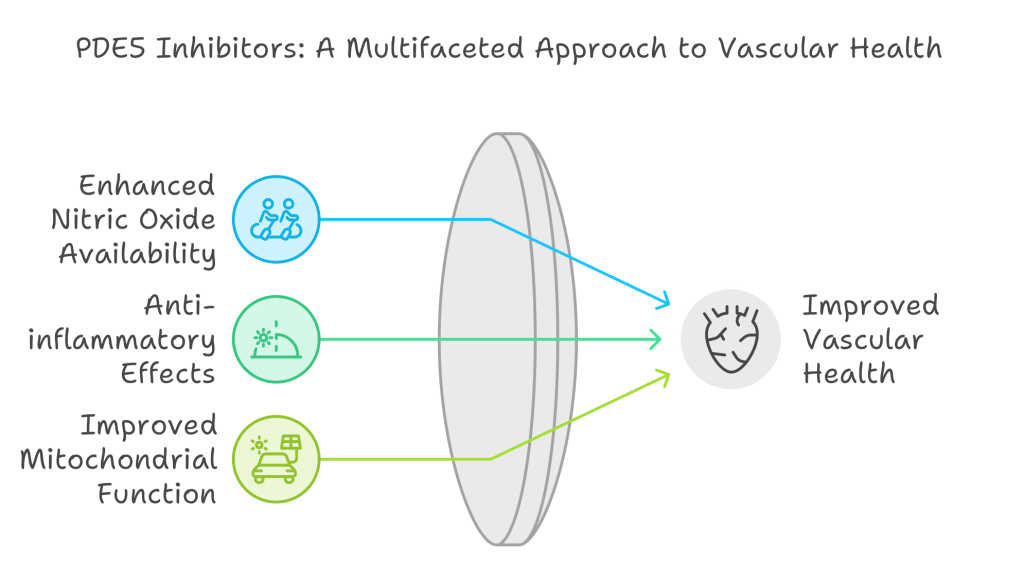
Cardiovascular disease remains the leading cause of mortality worldwide. The endothelial lining of our blood vessels plays a crucial role in vascular health, regulating blood flow and preventing atherosclerosis. PDE5 inhibitors have been shown to have endothelial-protective effects:
- Enhanced Nitric Oxide Availability: By increasing cGMP levels, PDE5 inhibitors enhance the effects of nitric oxide, a potent vasodilator that improves endothelial function1.
- Anti-inflammatory Effects: Chronic inflammation contributes to vascular aging. Recent studies suggest that PDE5 inhibitors reduce markers of inflammation within the vascular system2.
- Improved Mitochondrial Function: Mitochondrial dysfunction is a hallmark of aging. Research indicates that PDE5 inhibitors may improve mitochondrial efficiency in cardiac cells3.
Recent Clinical Evidence and Systematic Reviews
Several observational studies, clinical trials, and systematic reviews have explored the potential longevity benefits of PDE5 inhibitors:
- Systematic Review and Meta-Analysis (2023):A comprehensive systematic review published in the European Heart Journal – Cardiovascular Pharmacotherapy in 2023 evaluated the association between PDE5 inhibitor use and mortality rates in patients with cardiovascular diseases4.
- Findings: The review included data from multiple studies involving over 70,000 participants. It found that PDE5 inhibitor use was associated with a significant reduction in all-cause mortality and cardiovascular mortality compared to non-users.
- Implications: These findings suggest that PDE5 inhibitors may confer protective cardiovascular effects that extend beyond their use in treating ED.
- Reduced Mortality in Men with Coronary Artery Disease:A 2021 study published in Circulation followed men with coronary artery disease over several years5.
- Findings: Men using PDE5 inhibitors had a lower incidence of major adverse cardiovascular events and a reduced risk of death compared to those not using these medications.
- Improved Outcomes in Heart Failure Patients:Research has demonstrated that PDE5 inhibitors improved exercise capacity and heart function in patients with heart failure with reduced ejection fraction6.
Beyond the Heart: Cognitive Implications
- Neuroprotection:Enhanced blood flow from PDE5 inhibition could have neuroprotective effects. Some research indicates a potential for lowering the risk of cognitive decline and improving outcomes in neurodegenerative diseases7.
Caveats and Considerations
While the data is promising, it’s important to approach these findings with caution:
- Observational Limitations: Many studies are observational and cannot establish a direct cause-and-effect relationship.
- Population Specificity: Most research has focused on men with existing cardiovascular conditions. It’s unclear if these benefits extend to the general population or to women.
- Side Effects: PDE5 inhibitors are generally well-tolerated but can cause side effects like headaches, flushing, and, in rare cases, more serious cardiovascular events.
The Longevity Puzzle
Longevity is a complex interplay of genetics, lifestyle, and environmental factors. Medications like PDE5 inhibitors could be one piece of this puzzle, particularly through their cardiovascular benefits. However, they are not a magic bullet. Optimal health and longevity still rely heavily on diet, exercise, sleep, and stress management.
Final Thoughts
The potential for PDE5 inhibitors to contribute to increased longevity is a fascinating area of ongoing research. With the latest studies strengthening the evidence for their cardiovascular benefits, the medical community is paying close attention. As with any medical intervention, it’s crucial to consult with a healthcare professional before considering off-label uses of PDE5 inhibitors.
Stay Curious
Science continually evolves, and what we know about medications like PDE5 inhibitors today may expand tomorrow. Staying informed and curious is key to navigating the ever-changing landscape of health and longevity.
References
Footnotes
- Foresta, C., Caretta, N., & Rossato, M. (2008). Platelet tissue factor pathway inhibitor is reduced in patients with erectile dysfunction: effect of tadalafil treatment. The Journal of Sexual Medicine, 5(1), 48–53. ↩
- Vlachopoulos, C., et al. (2015). PDE5 inhibitors for cardiovascular disease prevention? Current Pharmaceutical Design, 21(28), 4097–4106. ↩
- Das, A., et al. (2015). Cardioprotection with phosphodiesterase-5 inhibition—a novel preconditioning strategy. Journal of Cellular and Molecular Medicine, 19(9), 1955–1963. ↩
- Pikilidis, P. I., Katsi, V., Papazoglou, A. S., et al. (2023). Phosphodiesterase type 5 inhibitors and mortality: a systematic review and meta-analysis. European Heart Journal – Cardiovascular Pharmacotherapy, 9(3), 207–214. https://doi.org/10.1093/ehjcvp/pvac029 ↩
- Anderson, S. G., Hutchings, D. C., Woodward, M., et al. (2021). Phosphodiesterase Type-5 Inhibitor Use and Risk of Mortality Following a Myocardial Infarction. Circulation, 144(8), 623–633. ↩
- Redfield, M. M., Chen, H. H., Borlaug, B. A., et al. (2013). Effect of phosphodiesterase-5 inhibition on exercise capacity and clinical status in heart failure with preserved ejection fraction: a randomized clinical trial. JAMA, 309(12), 1268–1277. ↩
- Zhang, R. L., Zhang, L., Zhang, Z. G., et al. (2012). Sildenafil enhances neurogenesis and oligodendrogenesis in ischemic brain of middle-aged mouse. PLoS ONE, 7(10), e48141. ↩
 Zehn Skin and Health
Leave a comment